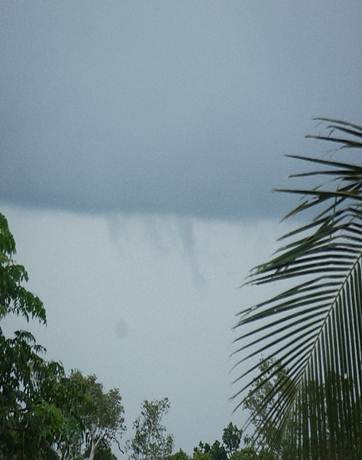
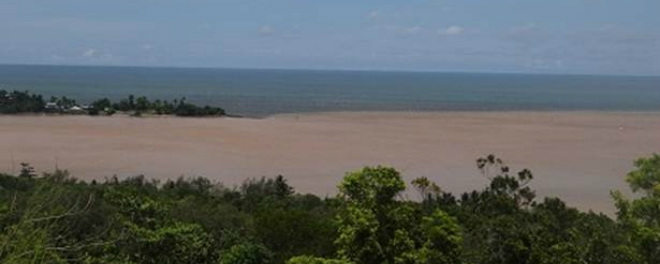
 | Hello from Coquette Point, The monsoon brought violent storms and heavy rain to the Cassowary Coast this week. The Johnstone River turned brown as it carried the priceless topsoil that was contained in run-off from farms out into the Coral Sea. |
Cassowary ‘Dad 4’ has established his territory in the melaleuca/mangrove forest at the Point and had chased ‘Big Sis’, now an adult, and his subadult chick ‘Q’ from the area. However his other chick ‘Don’ has remained in his territory. ‘Don’ doesn’t wait to be chased he runs off as soon as he sees his Dad. He is very timid and with his brown colouring quickly disappears into the foliage. ‘Dad 1’ and ‘Rosie’ travel from the top of the Moresby Range down to the Eastern mangrove forest. ‘Dad 1’ is dominant and with the exception of the matriarch ‘Jessie’ takes first picking from fruits on trees or at the feeding stations and at these times ‘Dad4’ has to wait.
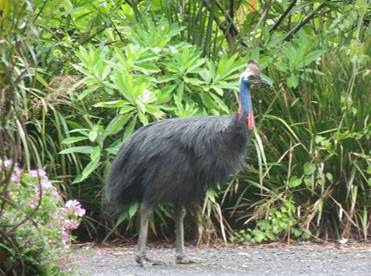 | 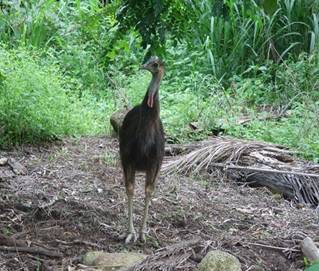 | 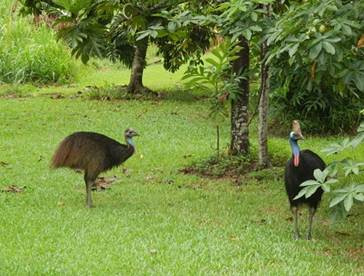 |
It is extraordinary that of the six cassowary chicks born late 2010 at Coquette Point three are still with their Dad.
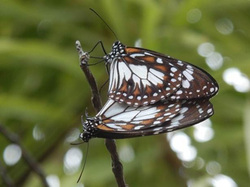
Lots of butterflies fluttering around the forest and the Swamp Tigers are mating.
Low tides in the early morning have been ideal for beach walking, necessary before the scorching sun rises and makes it unbearable to be outside.
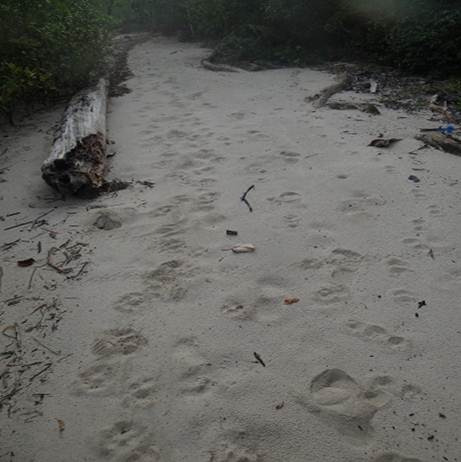 | 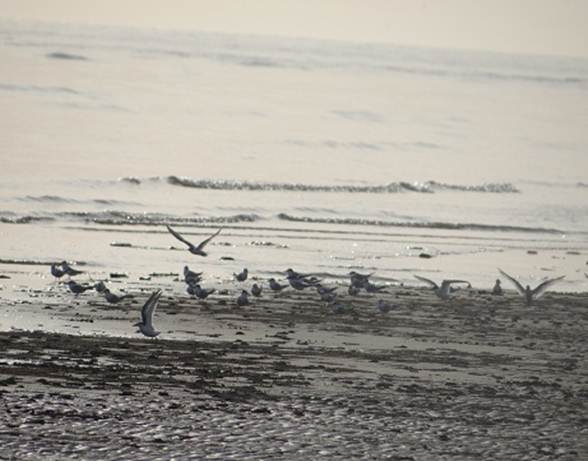 |
This morning fisherman catching bait from Crocodile Creek disturbed the Little Terns. As well, someone with a dog had gone before me and left a record of footprints in the sand. I saw the Little Terns in the air, over 40 birds. When they settled it was on a sandbank away from the rookery.
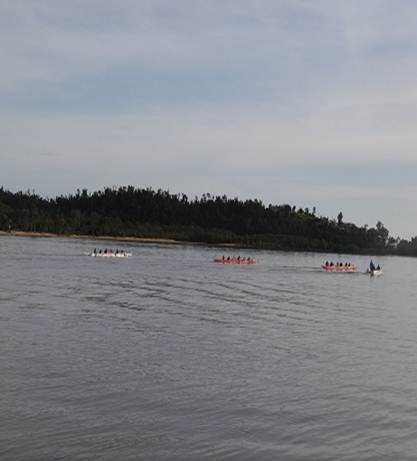
The Innisfail Outrigger Club had six boats in the Johnstone River this morning and I spoke to some of the rowers when they pulled up on the Spit for a rest and strategy meeting. They were very interested to learn about the Little Terns and we all watched the terns fishing in the early morning light.
One of the members, Donna, told me they had seen a Spoonbill on the mudflats off Vuleta Estates. They were also very excited to tell me that they had just seen a White-tailed kingfisher in the mangroves, its bright orange chest contrasting against the green foliage in the early morning light. The White-tailed Kingfisher is a migrant from New Guinea and visits North Queensland in summer to breed. It builds its nests in termite mounds usually on the forest floor. It is a thrilling sight to see this beautiful bird and I will be keeping a close lookout for it and the spoonbill.
The Innisfail Outrigger Club had six boats in the Johnstone River this morning and I spoke to some of the rowers when they pulled up on the Spit for a rest and strategy meeting. They were very interested to learn about the Little Terns and we all watched the terns fishing in the early morning light.
One of the members, Donna, told me they had seen a Spoonbill on the mudflats off Vuleta Estates. They were also very excited to tell me that they had just seen a White-tailed kingfisher in the mangroves, its bright orange chest contrasting against the green foliage in the early morning light. The White-tailed Kingfisher is a migrant from New Guinea and visits North Queensland in summer to breed. It builds its nests in termite mounds usually on the forest floor. It is a thrilling sight to see this beautiful bird and I will be keeping a close lookout for it and the spoonbill.
 | 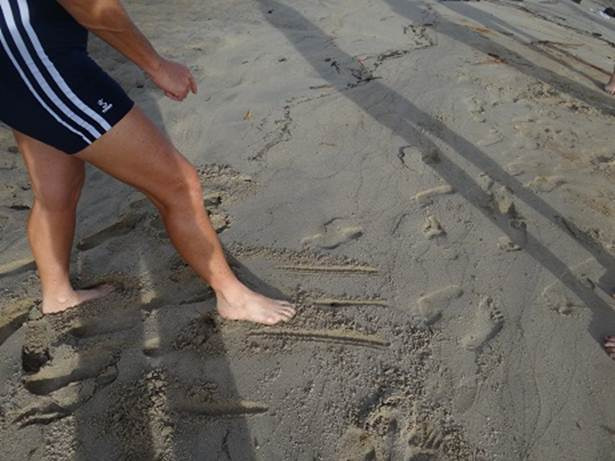 |
Donna drew a diagram in the sand to explain how a crocodile last week had come up on the sand and lay between their canoes: they had pulled them out of the water so they could have a rest. Unfortunately, none of them had a camera. They also told a story that two Japanese visitors in a canoe last week saw a small crocodile eat a shorebird, from their description is was a pied oystercatcher.
A visitor to the nursery this week from Palm Island made me think about how things have changed in the last 100 years and yet in so many ways they have stayed the same. David Ryan, a Djiru man, who was born at Palm Island in 1943 was looking up old friends in Innisfail and searching for anyone who had records of the Catholic Mission at Mission Beach. David’s mother Ena Bunting a Djiru women of Mission Beach was moved to Palm Island following a disaster. In 1918 a category 5 cyclone with a storm surge, said to be ten metres high, came ashore at Mission Beach. Many people died and the Catholic Church who had a Mission for the local Aboriginal people abounded the area soon after the cyclone. Many aboriginal people as well as nuns and priests died at the Mission on the 10 March 1918. It is said that the aboriginal people wanted to run inland, away from the coast when the cyclone came, but the priest said they had to stay and that they would be safe under the church. Many were drowned. Oral story told by Jack Fossey in 1976.
David has given me his phone number and if anyone has any information about his family he would like to speak to them. Ring me and I will pass on his contact.
Cheers for now,
Yvonne C.
David has given me his phone number and if anyone has any information about his family he would like to speak to them. Ring me and I will pass on his contact.
Cheers for now,
Yvonne C.